Category: Uncategorized

  • Weekly Med – Dec 29 2025

    by The Rev. Dr. David K. Popham

    Transforming the Public Square

    Thank you for inviting me to reflect with this community on how people of consciousness and compassion might show up in the public square. As I understand it, my task is to inspire us to go into 2026 ready to stand on the right side of history. I admit there is something exciting about crafting what may prove to be my version of the inspirational Shakespeare’s Henry V St. Crispin’s Day speech. In the play King Henry is encouraging his beaten-up and worn-out army to fight on toward a victory against the odds. Henry ends by reminding his troops how proudly they will be thought of for their courage and bravery: “And gentlemen in England now a-bed / Shall think themselves accursed they were not here, / And hold their manhoods cheap whiles any speaks / That fought with us upon Saint Crispin’s day.”

    No doubt a history whose arc bends toward justice will praise those who stand against cruel governmental attitudes and stand for those being swept up in our present political ranting. Yet, I think it’s wiser if we might go deeper than where a keep-up-the-good-fight reflection generally takes us.

    I agree with others that our public square has been turned into a stage for a spectacle of the absurd, where the hunger for validation eclipses the need for shared vision. Many of us have witnessed the injuries and wounds received from the hands of this spectacle. Some of us have been personally hurt. It is the hurting place I wish to address, if I may.

    I want you to know that the hurt you carry does signal an injustice, a wrong, a violation of who you are and how you are in the world. That pain is real and because it is real, it impacts how we go about being us. For unfortunately, hurting people hurts people. It is true of our national leaders, and it is true of ourselves as well. The problem with all this hurting is that it perpetuates the very cycle we want to overcome and stop.

    Here’s the rub: in order to heal our national hurt, we must first heal our personal hurt. In order to heal our personal hurt, we must touch the pain that lies within it. I can only speak for myself, I do a lot of things to avoid my personal pain. I’ve got a hurting place in me that is saturated with pain. It stretches all the way back to my childhood and hearing my mother saying she wished I had not been born. And now that hurting place is being poked by a government saying it wishes people with my sense of what is just did not exist. And this pain causes me to blindly strike out. Hurting people hurt people.

    The remedy for hurt is found in all the major world religions. I happen to speak the language of Christianity and so will use its vocabulary. When divine love touches our hurting place, mercy abounds. We experience this in the wounds of Christ abiding with him after the resurrection transformed into a testimony of perseverance.

    We watch the political stage from the margins, weary of the noise, the nationalistic promises, the endless clash of voices, the neo-fascism. We feel the tremor within – the fear that the world is unraveling, that our voice is too small, that we are unseen in the storm.

    Here is what we need to know: the outrage we carry is a restless wind. It lifts us for a moment, then leaves us to fall with a thump. Every argument we rehearse, every mask of certainty we wear, is a veil between us and the truth that alone can set us free. That the soul was not made for the fury of crowds but for the quiet work of healing.

    We fear weakness, yet weakness is the door to wisdom. We fear stillness, yet stillness is the soil where healing grows. I say, lay down the burden of guarding your hurt with anger. For what is victory if it costs us our peace? What is justice if it leaves us restless?

    Come away from the noise. Enter the inner chamber of your soul where no eye watches and no tongue flatters. There, in the secret place, you will find the One who knows you – and knows the pain you carry. In the Divine’s gaze, humility is not humiliation but liberation in mercy.

    Then return. Return as one made whole, carrying the quiet strength that comes from resting in infinite love. Show up in the public square not as a mirror of the nation’s hurting but as its antidote. The world does not need more noise; it needs voices born of wholeness. It does not need more power; it needs hearts that have learned peace.

    The call before us is not merely to resist the noise of a fractured world but to embody a deeper truth: that healing begins within. When we allow mercy to mend our wounds and love to quiet our outrage, we become more than participants in the public square—we become its transformation. Let us enter 2026 not as voices of anger but as bearers of peace, carrying the strength of wholeness into a world desperate for hope. This is how we stand on the right side of history: not by shouting louder, but by living the quiet revolution of compassion.

    And yes, those people unable to heal and unable to be bearers of peace, shall hold their experience cheap while any speak of their work of transforming the public square from a place of fear to a place of hope.

    Rev. Dr. David K. Popham

    The Rev. Dr. David Popham grew up in Kentucky where he graduated with a Bachelor of Arts in Religious Knowledge from the University of the Cumberlands and his Master of Divinity from the Southern Baptist Theological Seminary. He was ordained as an American Baptist and granted Privilege of Call by the Eastern Association of the Southern California/Southern Nevada Conference, UCC in 1995. After serving a United Church of Christ in Utah, he became Associate Conference Minister with the Rocky Mountain Conference, and then for the Central Atlantic Conference, UCC. David received his Doctor of Ministry Degree from Lancaster Theological Seminary and was elected by the 2019 Hawaiʻi Conference Aha Paeʻaina as Conference Minister. He is married to Kerrie Shahan and they make their home in Kailua, on the island of Oʻahu in Hawaiʻi. They have two grown daughters.

  • Weekly Med – Dec 22 2025

    by Rev. Brian G. Rallison

    — The Reverend Brian G. Rallison is an Episcopal priest at the Episcopal Parish of St. Clement and St. Clement’s School in Honolulu, dedicated to nurturing community, fostering service, and sharing Christ’s love through Word and Sacrament. He creates inclusive worship so that all can encounter God’s grace. Supporting individuals and families, Father Brian brings a pastoral heart. He holds a Master of Divinity from The Church Divinity School of the Pacific and a B.S. in Human Development and Family Studies from the University of Utah. Before ministry, he was an executive in mortgage banking. 

    Holiday Meditation

  • Weekly Med – Dec 15 2025

    by Dr. Alan Akana

    The Holiday Meditation this week is provided by Alan Akana. Rev. Dr. Alan Akana is an ordained minister in the United Church of Christ, and has served churches in California, Hawaii, Montana, Utah, and Texas. He is currently Kahu of Kōloa Union Church on Kaua`i. He has also worked in the areas of stewardship and fundraising for religious not-for-profit organizations. He is also a 
    published author and an accomplished watercolorist with a focus on the indigenous flowers of Hawai`i.

    Thoughts About Joy

    Aloha, I am Alan Akana, the Kahu at Kōloa Union Church on Kaua`i, and I’ve been asked to share a few thoughts about joy.

    Early this fall I came across an article that CNN put on their online “Health” page, and the article addressed why people sometimes have trouble experiencing joy. It caught my attention because I have been doing some writing on the topic over the past few years, and it confirmed something which I have believed for quite awhile. The article shared the thoughts of Dr. Judith Joseph, a board-certified psychiatrist and researcher who has made it her mission to study joy. She says “joy isn’t just a nice-to-have — it’s a part of who we are.” Dr. Joseph goes on to say, “We are built with that DNA for joy. It’s our birthright as human beings.”

    When you look into a newborn’s eyes and make a connection, face-to-face, that baby will look at you with a sense of wonder; if that baby likes what it sees in you, a heartwarming smile will follow—unbridled joy! That baby doesn’t care about your gender, sexual orientation, skin color, political preferences, or religion. When people connect with others in person and without judgment, we feel joy. It’s just how we are built. “We are built with that DNA for joy.”

    I think that Jesus understood this when he invited a small child to be present in the midst of his disciples and said to them, “Truly I tell you, unless you change and become like children, you will never enter the kingdom of heaven.” I like to think of the “kingdom of heaven” as “heaven on earth.” I am confident that Jesus wanted people to have the same sense of joy and wonder that babies and young children have when they encounter others. Wouldn’t this indeed be heaven on earth?

    However, we tend to lose that sense as we get older and learn to separate people into groups and then place labels on them, especially the labels “us” and “them.” Rather than looking at people through the eyes of wonder, we look through the lens of judgment, which nearly always leads to less joy for both. As we get older, we tend to look at people in this way, and that is a key reason why we sometimes feel less joy as we age.

    There is a lot in our culture that encourages us to move away from wonder and towards judgment. Our communities of faith often show us how to separate and label people in our minds: those who are chosen and those who are not; those who understand God best and those who understand God very little (if at all!); those who are forgiven and those who are not; those going to heaven and those going to hell. Our communities of culture (based on citizenship, ethnicity or tribal affiliation) do the same kinds of separating and labeling: those who matter more and those who matter less; those who are more civilized and those who are less so; those with a more worthy history and those with a history of little importance; those whose stories that are meaningful and those whose stories have very little meaning. Finally, I don’t think anyone will be surprised by the statement that our politics do the same type of separating and labeling: those who honor our forebears and those who do not; those who understand our government and those who have little or no understanding; those whose morals guide their understanding of politics and those who have little or no ethical standards applied to politics.

    However, it doesn’t have to be this way. We can all approach the strangers in our midst with wonder and joy; and we can teach our children, our students, and our congregants to do the same. May we be committed to doing so.

  • Weekly Med – Dec 8 2025

    by Rev. Cheri Dennis

    The Holiday Meditation this week is provided by the Rev. Cheri Dennis. Cheri Dennis is an ordained minister in the United Church of Christ currently serving as pastor of Lihue Christian Church on Kaua’i Island. Cheri is currently serving as the chair of the Justice and Witness Missional Team for the Hawai’i Conference United Church of Christ. Being a pastor is her third career after 10 years as a medical secretary and 30 years as an accountant. She is a native of North Carolina who is finding life on Kaua’i a wonderful experience. The diversity of the people of Hawai’i and the flora and fauna of the islands is a beautiful tapestry of creation woven by God. 

    The Angels of Christmas

    Who are “The Angels of Christmas”? Let’s see. There’s the angel Gabriel who delivered a message of hope to Elizabeth & Zechariah that they would have a son in their old age, one who would prepare the way of the Lord (Luke 1:5-25).

    The angel Gabriel also told Mary that she would have a son, the Son of God who would “scatter the proud, bring down the powerful, lift up the lowly, fill the hungry, and send the rich away empty” (Luke 1:26-56).

    Then we have the Angel of the Lord who delivered not one but three messages to Joseph; that he should marry Mary (Matt 1:20-25), that he should take his family should flee to Egypt because their lives were in danger (Matt 2:13-15), and that it was safe to come back to Nazareth (Matt 2:19-23).

    And who can forget the Angel of the Lord who, along with a multitude of heavenly hosts, appeared to the shepherds saying, “Glory to God in the highest heaven, and on earth peace among those whom God favors.” (Luke 2:8-20)

    The messages the angels brought to the shepherds and to a weary world were ones of hope, peace, joy, and love.

    I’ve probably read these stories hundreds of times over the years. This time, however, I was struck by the fact that none of the stories describe the angels as having wings, let alone flying!

    They also don’t have halos! In fact, they take human form. And rather than flying in the sky, they are often described as standing before the recipient of their messages. I wonder, if angels come in human form, do we recognize the angels standing before us? Are there angels in our lives who stand in front of us with messages from God? Do we hear them?

    On the other hand, I also wonder, since I’m a human in human form, am I to be someone’s angel? Should I be an angel with a message from God? A message of hope, peace, joy, and love?

    For we know that these are the words humanity needs to hear now. These are also the words you and I need to hear as we continue to work for justice and equity in our world. Jesus came to bring peace to the world, peace through loving our neighbor as we love ourselves. And we are called to continue this work.

    May you be encouraged by angels in continuing the work of justice and peace. And may you be an angel of God for someone else as you continue God’s work of bringing peace and peace to this world.

    “Do not neglect to show hospitality to strangers, for by doing that some have entertained angels without knowing it.” Hebrews 13:2 (NRSV)

  • Weekly Med – Dec 1 2025

    by Rev. Roxanne Whitelight

    This is the Sixth of our Holiday Season Meditations. Rev. Roxanne is a retired minister living in Maui. She most recently has been offering pulpit supply for congregations needing short term support due to the absence of their regular minister. She has served Lutheran Churches, United Church of Christ Churches and Episcopal Churches in her 32 years of ordained ministry. She also spent her early career as a psychotherapist, educator, and body worker. Her current motto is: Kindness is my religion. We are delighted to have her as a member of Hui Aloha ‘O Maui Indivisible.  Please enjoy Rev Roxanne’s video message titled “Peace, are you kidding”?

  • Weekly Med-Nov 24 2025

    by Rev. Dr. Scott Landis

    This week our meditation is provided by the Rev. Dr. Scott Landis. Kahu Landis lives on Maui with his husband Randy. He came to Maui nearly 6 years ago to be the interim Kahu at Keawala’i Congregational United Church of Christ in Makena, fell in love with the island, and made it his home. An avid paddler, he also serves on the Hui Aloha/Shine Your Light Leadership team. 

  • Weekly Med-Nov 17 2025

    by Rev. Canon Franklin S. H. Chun

    We are very blessed this week to have a meditation from the Rev. Canon Franklin S.H. Chun. Father Franklin Chun is a priest in the Hawaii Episcopal Diocese and serves as chaplain to the retired clergy.  He is co-author of Da Jesus Book, a translation of the Bible into pidgin.  He is a tireless advocate for the poor and the oppressed. And this week, we are very blessed and thankful to have him share his thoughts in this thanksgiving season!

    Here is Father Chun’s meditation:

    I have a confession . . . There have been times when I have forgotten to give thanks!  Auwe!  And, there have been times when I should’ve counted my blessings, but I didn’t.  To which my Chinese grandfather would say, “Ai-yah!”  I liken it to those dilemmas where you see one thing, and somehow overlook the other, more positive side.  For example, the chalice at the altar may be half-empty.  Ah yes, but did you take into account that it is also half-full!

    In this new season of Thanksgiving then, let’s challenge ourselves to give thanks by focusing on the more positive.  Here’s a very short list of examples, which someone had earlier shared with me:

    My eyesight is poor.  But ITG (I thank God) that I’m not yet blind.

    A new gray hair?  ITG.  A friend in chemo has no hair at all.

    In church, some of you sing off-key.  But ITG, because it means that I still have my hearing.

    My family lives with me.  ITG, because some may be without close-ones living nearby.

    The alarm awakens me in the morning.  ITG that, like Ebeneezer Scrooge, I am still alive, and I can even ponder what life is all about!

    Aching muscles and weariness at the end of the day?  ITG.  It means that I have been productive.

    Hearing all the complaining about the present administration,  ITG, because it means that we still have freedom of speech!

      Should you find yourself the victim of other people’s bitterness and smallness.  Thank God!   Things could be worse — You could be one of them!

    I may not have all I want, but ITG that I have all I need

    Count your blessings, and give thanks to God!  (see Scripture below)   — Frank


    The Rev. Canon  Franklin S.H. Chun

    From the Hawaii Pidgin Bible, Da Good An Spesho Book:

    “Neva mind da fig tree no mo bud;  Neva mind da grape plant no mo grape;  Neva mind da olive tree no mo da olive;  Neva mind da fields no mo food.  Neva mind da sheep mahke, an da pens no mo cows . . . I still yet goin stay gud inside, cuz God goin get me outa trouble!”   (Habakkuk taik fo God  3:17-18)

    English Standard Version:

          “Even though the fig trees have no fruit, and no grapes grow on the vines;  Though the olive crop fails, and the fields produce no grain;  And even though the sheep all die, and the cattle stalls are empty . . . I will still be joyful and thankful, because God is my savior!”   (Habakkuk  3:17-18)

  • Weekly Med-Nov 10 2025

    by Father David Gierlach

    Father David Gierlach is a retired priest in the Episcopal diocese of Hawaii, having served actively for nearly 20 years.   He is also a retired attorney and per diem Judge and he is active in various social justice movements.  We are delighted to have him as a member of our Hui Aloha/Shine Your Light Team. 

    Please enjoy Father’ David’s meditation on “A Church Reborn.


  • Weekly Med-Nov 5 2025

    by Ellen Caringer

    Those of us who followed the WWII generation are likely to remember our history lessons, and those who do, fully recognize we, as a country, are lurching rapidly toward fascism. The sign above encapsulates the reason our work is so crucial.  In the past year, I have often heard the phrase “If you ever wonder what you would’ve done had you lived in the days leading up to Nazi Germany, you are doing it now.” This work may feel very hard and overwhelming, but in the midst of the challenges we face, I have found renewed strength by reflecting on the incredible work each of you do, and the bonds we have established in working together. Courage is contagious and as we each stand up to insist that the current situation is unacceptable, we give strength to each other.  

    As we enter this season of thanksgiving, we may find it a little more challenging to be thankful, but exercising gratitude is quite essential to our spiritual and mental health. As a mental health provider, I’ve had more than the usual amount of discussions this year on finding ways to cope in the midst of the authoritarian breakthrough in our country.  Those who lived through those times in World War II tell us they were able to maintain their equilibrium by focusing on the simple joys in their lives. In the 1940’s, as now, it is essential for our health that we take time to enjoy the little things, be it the wonder of the holidays, or the love of family and friends. It is essential that we let NO ONE rob us of our blessings and joys. Let us make every effort to go the extra mile in creating joy in our lives and the lives of others.  Create magical moments for ourselves, our friends and our family, particularly in this season of the year. It is those moments that give us the fuel we need to do the work we must continue to do.  

    We also know that simply worrying, without taking action, enhances fear, depression and isolation. People fare far better when they join others in taking actions that can make a difference. Whether it be gathering up food to give to our immigrant brothers and sisters, writing postcards, or going to a protest or rally.  

    We also have to find that balance to stay healthy and at our best. I often recommend what I  call the “zoom in, zoom out” method of self-care.  “Zoom out” and look at the bigger picture, decide what steps you can take to contribute to saving our country and our democracy, take actions that feel right for you (write postcards, go to a protest, volunteer with an Indivisible group) then zoom back into your daily life. As we close out the last two months of this year, I urge you to practice being in the moment, whether providing a service to others or creating joyous moments with family. Treasure each of those life experiences.

    In this holiday season, our Hui Aloha team will be providing a weekly devotion or video to speak to surviving and thriving in this holiday season. Today is our first.  Each Monday, during the holiday season, our team members and Hui Aloha members will be sharing messages of love, hope and peace to help us as we navigate this holiday season.   

    Sending much aloha to all of you!

    Ellen


  • Arun Gandhi Interview

    by Ellen Caringer & Rev. Danette Kong

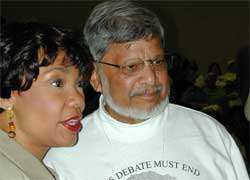
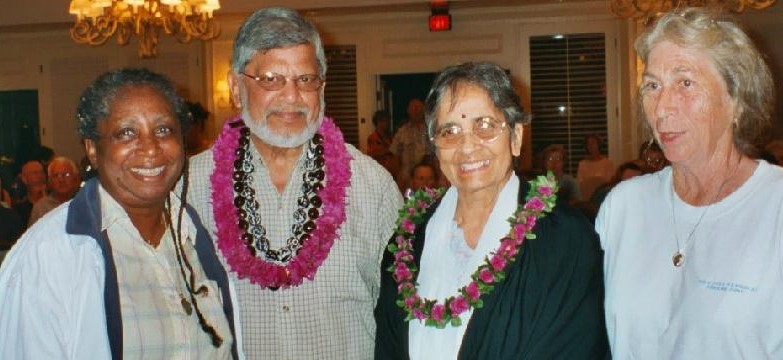
    Arun Gandhi is a journalist and activist who has made it a lifelong mission to promote non-violence. His parents and grandfather, Mahatma Gandhi, played strong roles in leading him along this path, which has taken him from South Africa, to India, and to the United States. With such life experience, he has observed great diversity and provides many lessons to us regarding racism, materialism, non-violence, and our personal responsibilities. As part of the “Stories of Light” series, he is interviewed by Shine Your Light team members, Dr. Ellen Caringer and the Rev. Danette Kong of Maui, Hawai`i, USA.

    Arun & Sunanda Gandhi visiting Maui
    Yolanda King & Arun Gandhi